


Short video platforms such as Douyin, TikTok, and YouTube face the challenge of massive amounts of user-generated content, where detecting duplicate videos and reuploaded content has become a core technical issue in platform content management. This report provides an in-depth analysis of how these video platforms determine video duplication and reuploading behavior, explores the algorithmic technologies used, and explains how they work in detail through specific examples.
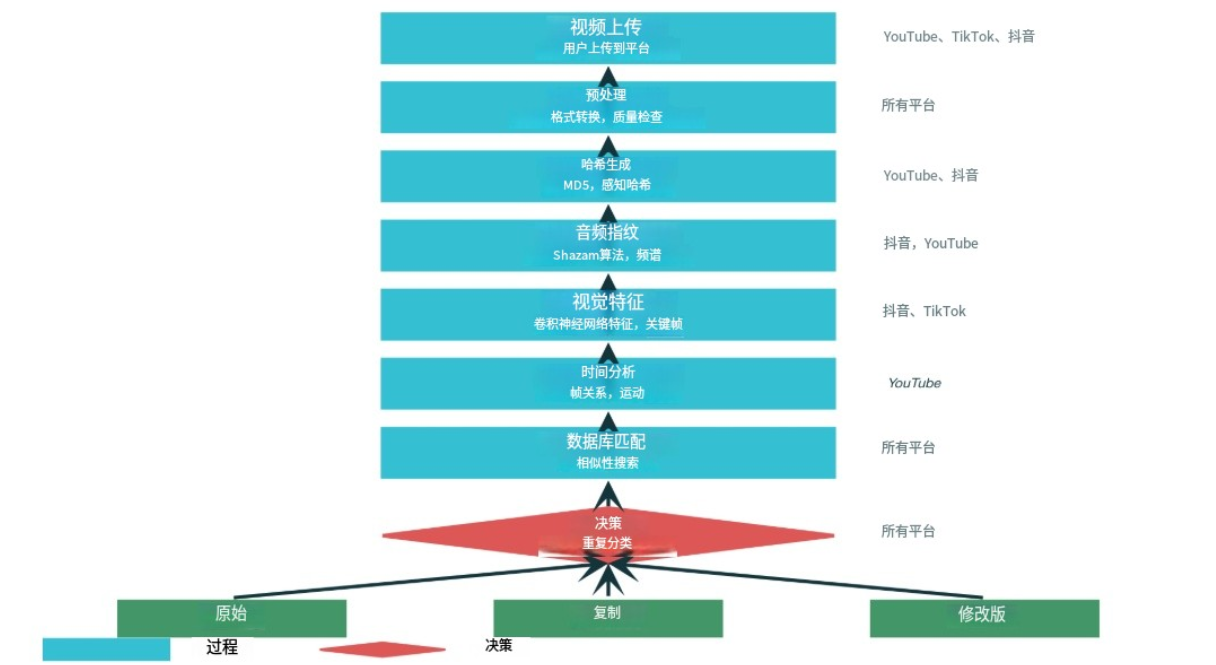
Basic Methods for Duplicate Detection on Video Platforms
Hash Comparison Technology
Video platforms first use hash comparison technology, which is the most basic but also the fastest detection method. Platforms generate multiple types of hash values for each uploaded video:
MD5 hashing is the simplest method, identifying completely identical files by calculating the MD5 value of a video file. When users directly upload an unmodified video, the system can detect duplicate content by matching the MD5 value within milliseconds. However, this method cannot detect videos that have undergone any editing, as even simple format conversion or compression will produce a completely different MD5 value.
Perceptual hashing is more advanced and can detect videos that are visually similar but technically different. The system extracts key frames from a video and generates a fixed-length hash code through DCT (Discrete Cosine Transform) or other algorithms. The similarity between the perceptual hash values of two videos is calculated using Hamming distance. If the Hamming distance is below a set threshold, the content is determined to be duplicate.
Audio Fingerprinting Technology
Audio fingerprinting technology is an important method used by video platforms to detect reuploaded content, with the most well-known being audio recognition technology based on the Shazam algorithm. This technology analyzes the spectral characteristics of audio signals and generates unique "audio fingerprints" to identify identical or similar audio content.
The process of generating an audio fingerprint includes: first sampling the audio at 44.1kHz, then generating a spectrogram through **Short-Time Fourier Transform (STFT)**. The system extracts peak points from the spectrogram, which represent the most significant frequency components in the audio signal. Next, the algorithm pairs these peak points to form a "constellation map," with each pair containing two frequency values and the time difference between them: .
Visual Feature Analysis
Modern video platforms widely use visual feature extraction technology based on deep learning. Through deep learning models such as convolutional neural networks (CNNs), systems can extract high-level semantic features from video frames. These features capture the essence of the video content rather than superficial pixel information.
The advantage of this method is that it can detect videos that have undergone complex editing, such as color grading, cropping, adding watermarks, and speed changes. Even if a video changes significantly at the pixel level, its deeper semantic features often remain relatively stable.
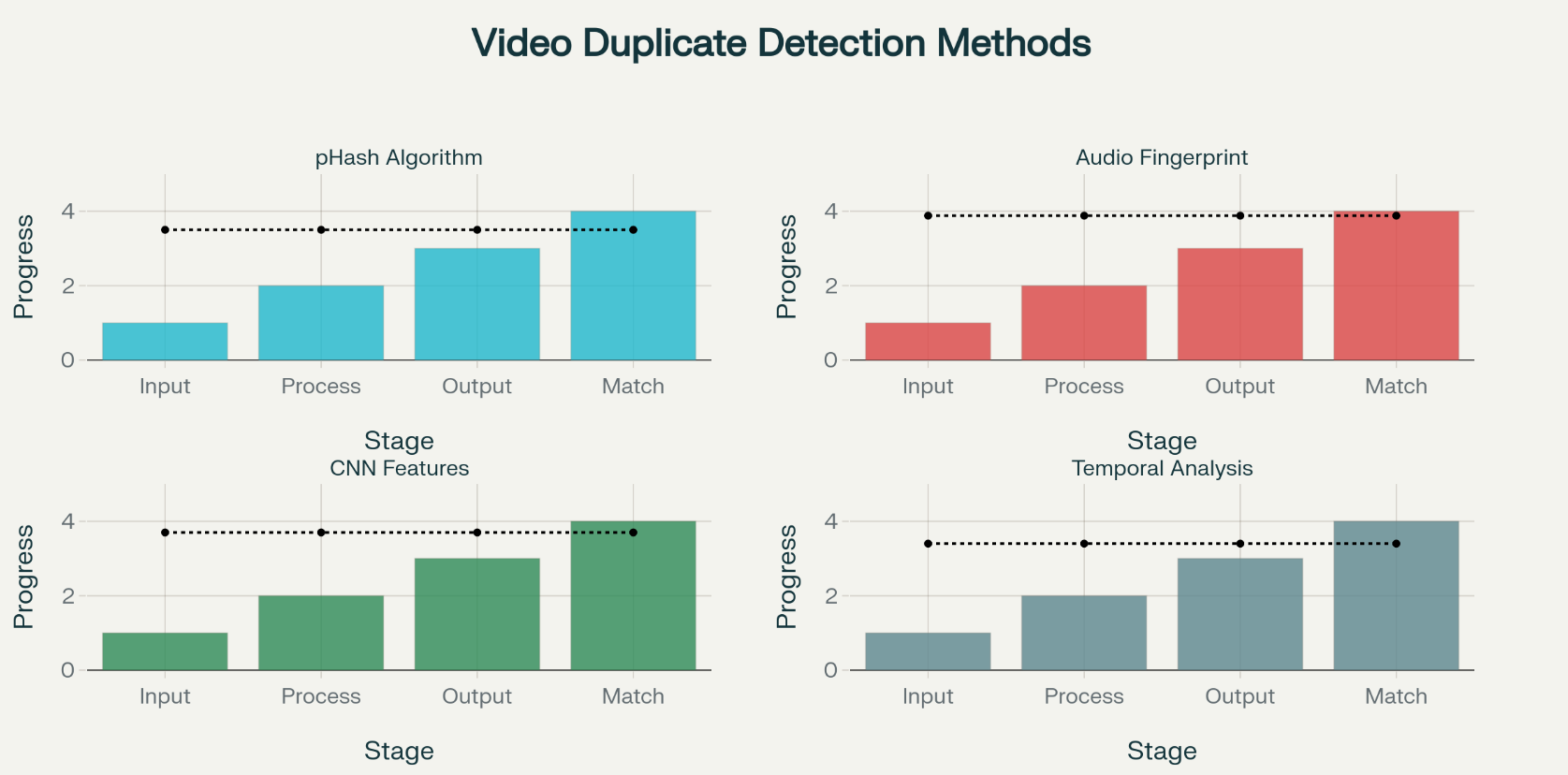
Temporal Consistency Detection
Temporal consistency analysis is another important dimension for detecting video reposting. This technology identifies duplicate content by analyzing the temporal relationships and motion continuity between video frames. The dual-level detection method is a major breakthrough in this field, including two levels: video editing detection (VED) and frame scene detection (FSD).
The video editing detection module first determines whether a video has been edited. For unedited videos, the system uses random vectors as descriptors to save computing resources. For edited videos, the system performs more in-depth frame-level analysis, including detecting whether multiple scenes have been spliced together in the video.
Detailed Explanation of Core Algorithm Technologies
Perceptual Hash Algorithm Family
The pHash (perceptual hash) algorithm is a widely used technology in video duplicate detection. The algorithm generates a hash value through the following steps: first, it scales the image to a standard size of 32×32 pixels, then applies the discrete cosine transform (DCT) to extract the image's frequency-domain features. Next, the algorithm retains the upper-left 8×8 region of the DCT coefficients (the low-frequency part), calculates the mean of these coefficients, and finally generates a 64-bit binary hash code by comparing each coefficient with the mean.
The dHash (difference hash) algorithm uses a different strategy. It scales the image to 9×8 pixels and then calculates the differences between adjacent pixels. If a pixel is brighter than its neighbor on the right, it is recorded as 1 in the hash code; otherwise, it is recorded as 0. This method is more sensitive to horizontal changes in the image and can better capture the image's structural features.
In-Depth Analysis of Audio Fingerprinting Algorithms
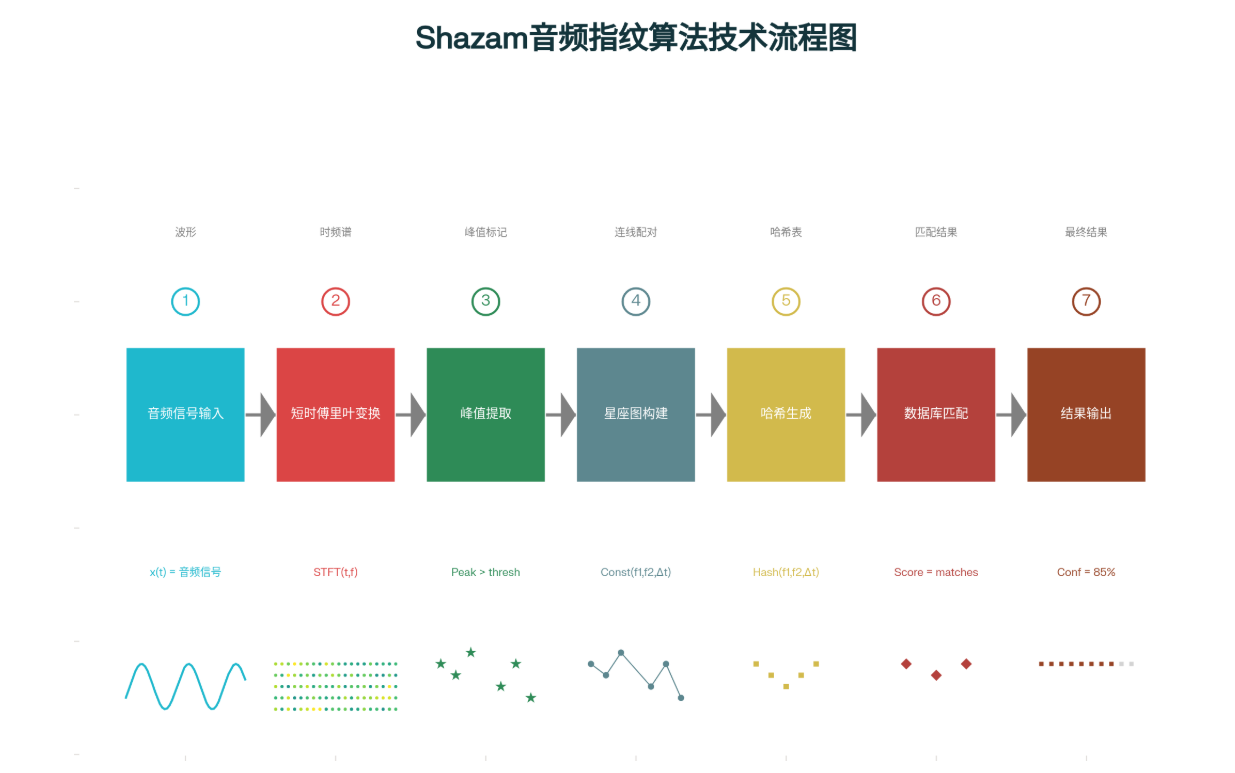
The core of the Shazam algorithm lies in constellation map matching technology. The algorithm first converts the time-domain audio signal into a frequency-domain representation through the fast Fourier transform (FFT):
Here, represents the audio sample points within the time window, and is the complex exponential function.
The peak extraction process identifies prominent feature points in the spectrogram by setting a threshold:
STFT(t,f) & \text{if} STFT(t,f) > threshold \\ 0 & \text{otherwise} \end{cases}$$ The construction of the constellation map is a key step in the algorithm. The system pairs the extracted peak points, with each pair containing two frequency values and the time difference between them. This pairing method gives the algorithm strong robustness against noise and slight audio distortion.[4] The hash generation process converts the constellation map information into a compact digital fingerprint: $$Hash(P1, P2, \Delta t) = Hash(f1, f2, \Delta t)$$ This hash value is stored in the database as a unique identifier for the audio segment and used for subsequent fast matching.[4] ### Deep Learning Feature ExtractionSelf-supervised video hashing (SSVH) technology represents the latest application of deep learning in video duplicate detection. This technology uses a hierarchical binary autoencoder architecture, including an encoder and three decoders: a forward hierarchical binary decoder, a backward hierarchical binary decoder, and a global hierarchical binary decoder.
The encoder uses a binary LSTM (BLSTM) structure, which can directly generate binary hash codes without post-processing steps. The data flow of BLSTM follows the pattern of standard LSTM, but adds the sign function at the end to produce binary output.
To solve the NP-hard problem of binary optimization, the algorithm uses an approximate sign function:
-1 & \text{when} h < -1 \\ h & \text{when} -1 \leq h \leq 1 \\ 1 & \text{when} h > 1 \end{cases}$$ This approximation allows gradients to pass through the sign function during backpropagation, enabling the entire network to be trained end to end.[9] ### Temporal Consistency Analysis AlgorithmThe temporal consistency reranking algorithm is the core technology for video segment localization. The algorithm first extracts image-level features through keypoint aggregation and deep learning, then uses a multi-k-d tree structure for efficient KNN search to obtain a set of candidate video segments.
The innovation of the algorithm lies in the temporal consistency pruning step, which accurately identifies matching segments and their temporal positions in the sequence by analyzing the timestamp information and sequence IDs of candidate segments. This method can complete a single-frame query in a database of 1 million frames at a speed of 83.96 milliseconds, with a query time of 462.59 milliseconds in a database of 4.5 million frames.
Analysis of Specific Implementation Cases
YouTube Content ID System
YouTube's Content ID system is one of the most mature copyright detection technologies in the industry. The system uses a multi-layer detection strategy:
The first layer is audio fingerprint matching. The system generates an audio fingerprint for each uploaded video and compares it against a massive reference database. Even if the audio has undergone pitch changes, speed adjustments, or added background noise, the system can still detect matching content through spectral analysis.
The second layer is visual content analysis. The system uses deep learning models to analyze visual features of the video, including color distribution, texture patterns, object recognition, and more. These features are encoded as high-dimensional vectors, and video similarity is determined through cosine similarity calculation.
The third layer is metadata comparison. The system compares metadata information such as the video's title, description, and tags, and makes a comprehensive judgment based on the results of the above technologies.
TikTok/Douyin's Dual Detection Mechanism
Douyin and TikTok use a dual detection mechanism to address the special characteristics of short videos:
Real-time detection: During the process of uploading a video, the system calculates the video's perceptual hash and audio fingerprint in real time. Through rapid comparison with the existing database, the system can identify obvious duplicate content within a few seconds.
Offline in-depth analysis: For videos that pass real-time detection, the system performs deeper analysis in the background. CNN models are used to extract semantic features and analyze the content originality of the video. For videos with slight modifications detected, the system calculates a similarity score, and content exceeding the threshold is flagged as suspected reposting.
Actual Detection Performance Data
According to research data, modern audio fingerprinting technology can achieve 100% recognition accuracy under ideal conditions:
-
1-second audio clip: 60% recognition accuracy
-
2-second audio clip: 95.6% recognition accuracy
-
5 seconds or longer: 100% recognition accuracy
For video detection, the two-layer detection method achieved a 98.8% recall rate on the FIVR-200K dataset and a 94.1% recall rate on the VCSL dataset.
The performance of perceptual hashing technology is as follows:
-
Processing speed: less than 1 millisecond per frame
-
Storage efficiency: only 8 bytes of hash storage required per video frame
-
Detection accuracy: up to 85-90% accuracy for slightly modified videos
Challenges and Technology Trends
Responding to Adversarial Attacks
With the global boom in short videos, content reposters are also constantly upgrading their anti-detection methods. Adversarial attacks are one of the main challenges currently faced. Attackers try to deceive detection systems by adding tiny perturbation signals to videos or using specific editing techniques.
To address these challenges, platforms are developing more robust detection algorithms. For example, topological fingerprinting technology uses persistent homology theory to analyze the topological structure of audio signals, making it more robust against time stretching and pitch changes.
Multimodal Fusion Detection
Modern video detection systems increasingly adopt multimodal fusion strategies. By simultaneously analyzing a video's visual content, audio features, text information (such as subtitles and titles), and social network propagation patterns, the system can build a more comprehensive content fingerprint.
The advantage of this approach is that even if one modality is deliberately modified, features from other modalities can still provide effective detection signals. For example, even if the video footage is substantially altered, its audio features and propagation patterns may still reveal that it has been reposted.
Edge Computing Optimization
In the future, video detection is moving toward real-time performance and lightweight deployment. New algorithm designs focus on:
Computational efficiency: developing lightweight detection algorithms that can run on mobile devices, reducing reliance on cloud services.
Real-time capability: enabling real-time detection during the video upload process, rather than the traditional post-processing model.
Privacy protection: performing content detection while protecting user privacy, avoiding leakage of original video content.
Algorithm Performance Comparison
Different detection algorithms have their own advantages and applicable scenarios:
MD5 hashing is suitable for detecting completely identical files, offering extremely high speed and accuracy, but it cannot handle any form of modification.
Perceptual hashing strikes a good balance between speed and robustness, making it suitable for detecting slightly modified content and the preferred technology for most platforms.
Audio fingerprinting provides extremely high detection accuracy for audio content and can maintain good performance even with background noise, but its computational complexity is relatively high.
Deep learning methods can understand the semantic content of videos and have strong detection capabilities for complex edits, but they require substantial computing resources and training data.
Temporal analysis excels at detecting the splicing and recombination of video clips, but its processing speed is relatively slow, so it is usually used as a secondary verification method.
In practical applications, video platforms usually adopt a multi-algorithm fusion strategy, dynamically selecting the most suitable algorithm combination based on the characteristics of the video and detection needs. This layered detection architecture ensures comprehensive detection while also taking computational efficiency and cost control into account.
Final Thoughts
Current mainstream technical approaches include perceptual hashing, audio fingerprinting, deep learning feature extraction, and temporal consistency analysis, each with its own unique advantages and applicable scenarios. As artificial intelligence continues to develop, future detection systems will become more intelligent, real-time, and accurate, while also needing to strike a better balance between technological progress and user experience.